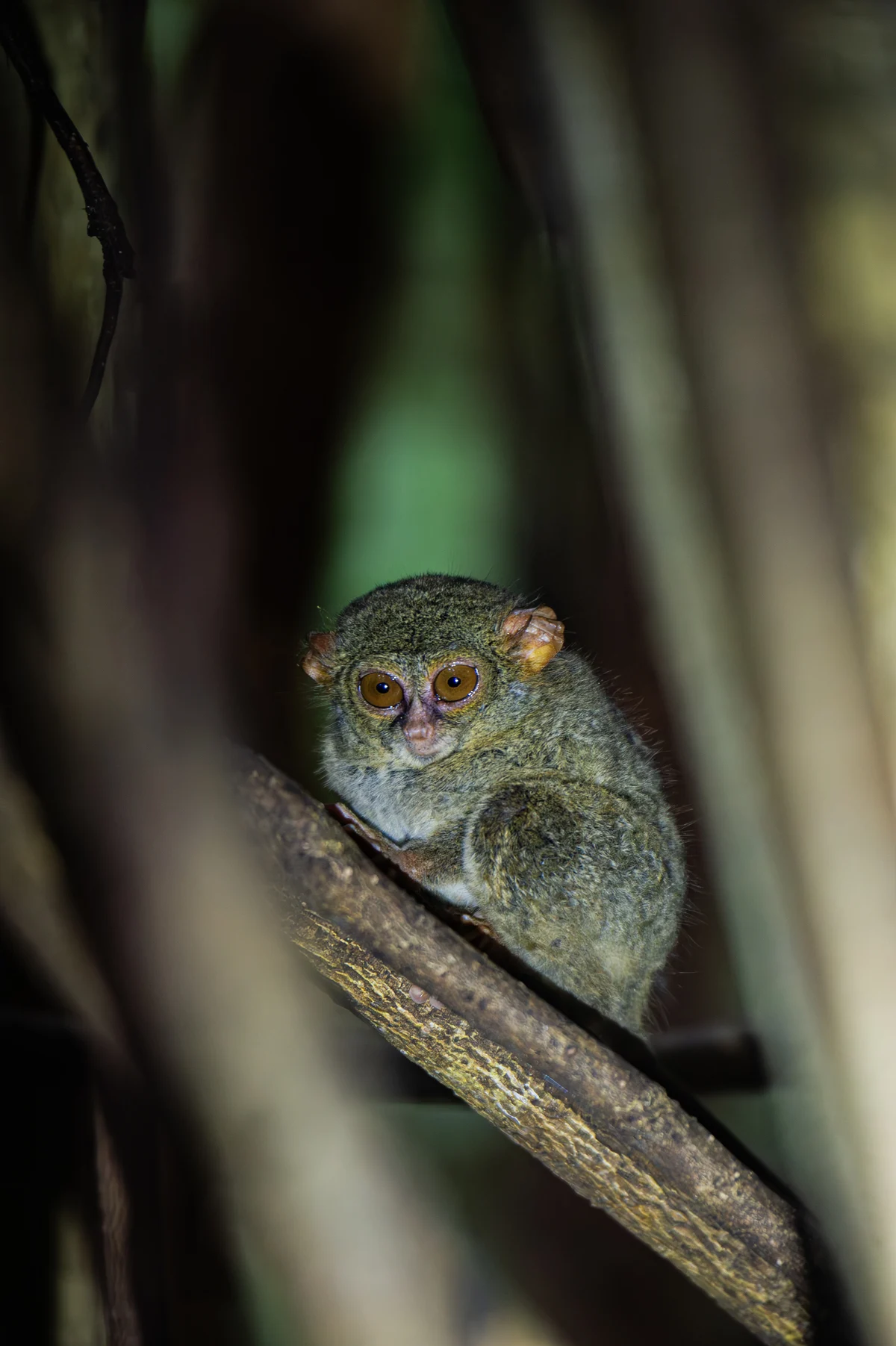
Return & duet call
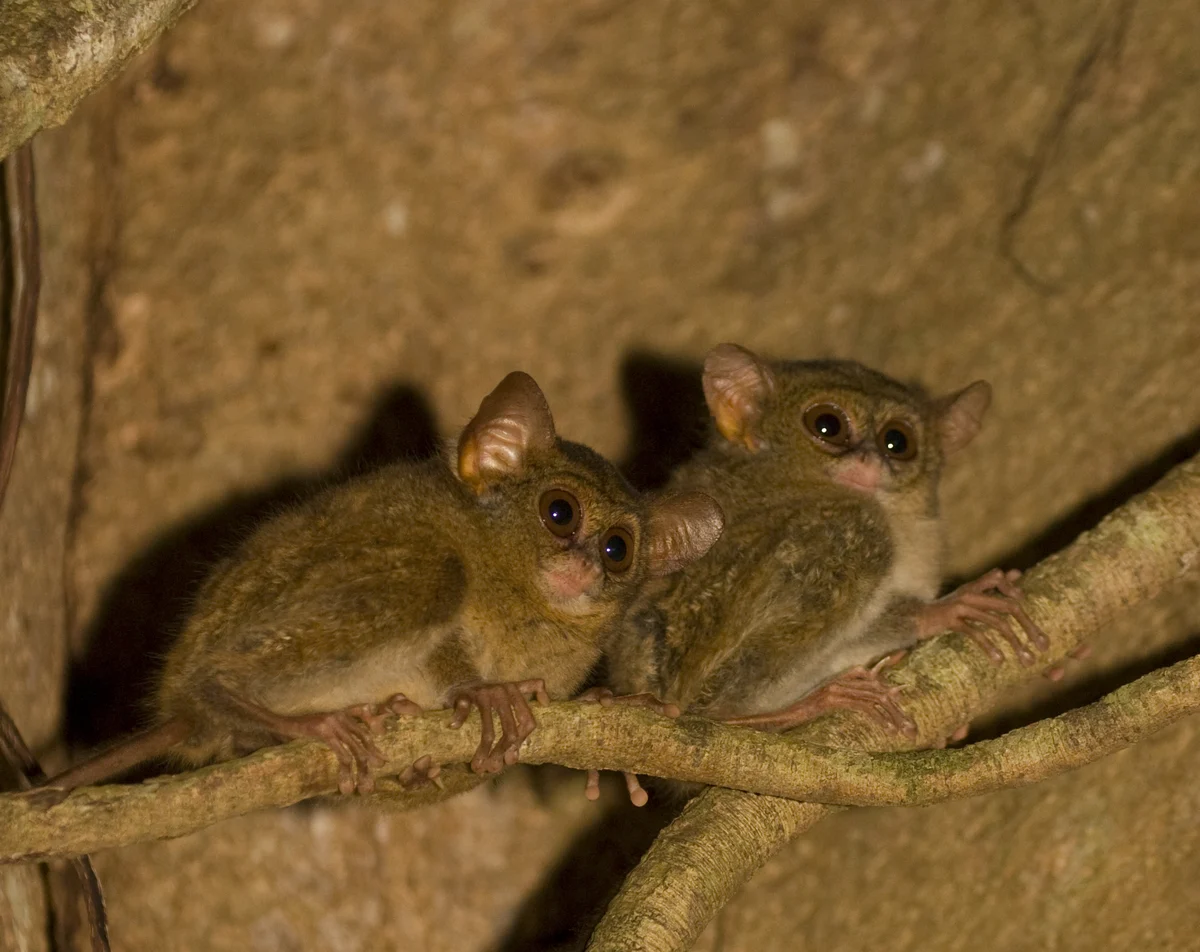
Just before sunrise, the family returns to their sleeping tree…

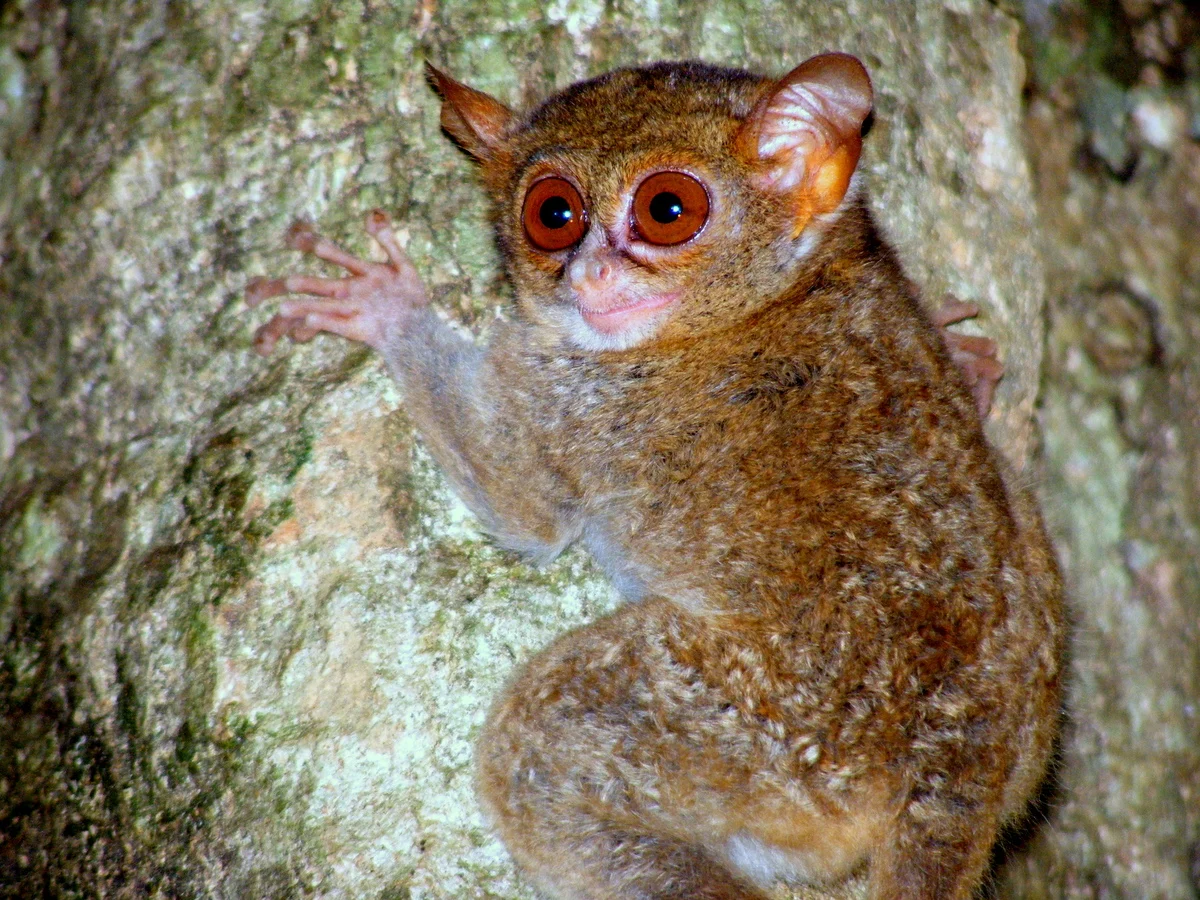
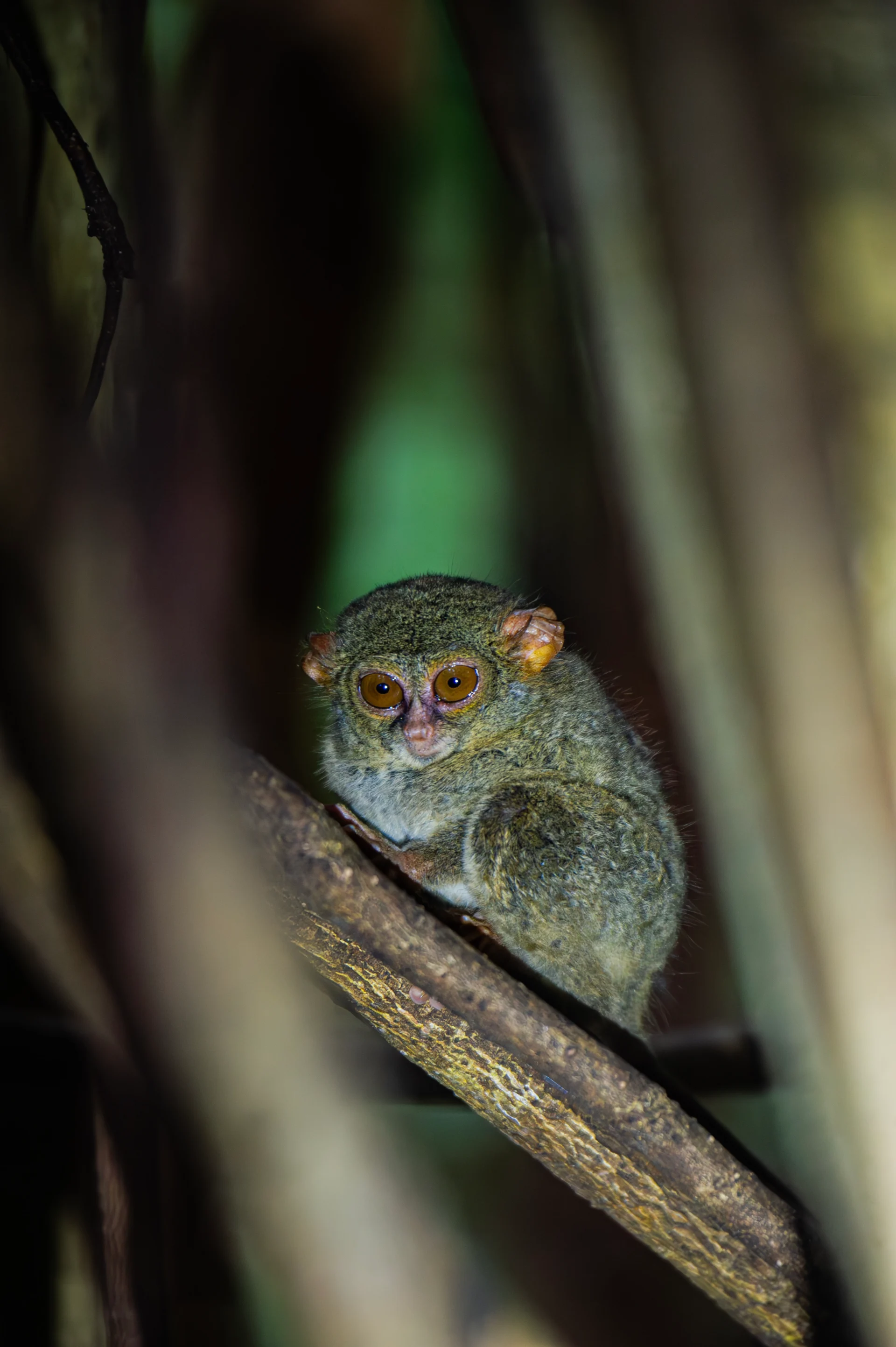
With eyes the size of its brain and the ability to rotate its head 180°, the Spectral Tarsier is one of Earth’s most extraordinary creatures — and Tangkoko is where you find them.
Deep inside Tangkoko Nature Reserve in North Sulawesi, hidden within the roots and fig trees of one of the world’s oldest forests, lives a creature unlike any other on the planet.
The Spectral Tarsier — scientifically known as Tarsius tarsier — is a primitive primate that has remained virtually unchanged for 45 million years. It is the only fully carnivorous primate on Earth, the only primate that cannot move its eyeballs (compensating with a near-360° neck rotation), and one of the few mammals that communicates in pure ultrasound.
Tangkoko is one of the last strongholds for these remarkable animals. The reserve’s protected lowland rainforest provides the dense, undisturbed habitat they need to survive. For wildlife lovers visiting North Sulawesi, a tarsier sighting is the experience of a lifetime.
This guide will tell you everything you need to know about Tarsius — their biology, behavior, conservation story, and exactly how to find them on a guided Tangkoko tour from Manado.
Scientific name
Tarsius tarsier
Body length
10 – 15 cm
Weight
80 – 160 g
Eye diameter
16 mm
Leap distance
Up to 5 m
Activity
Nocturnal
Diet
Insects, lizards
Lifespan
Up to 24 years
IUCN Status
Vulnerable
Endemic to
Sulawesi, Indonesia
45M
Years of evolutionary history — one of Earth’s oldest primates
180°
Head rotation range, compensating for their fixed eyes
5 m
Maximum leaping distance — 40× their own body length
8
Known tarsier species worldwide, all found in Southeast Asia
Anatomy & Biology
The tarsier’s anatomy is a masterclass in nocturnal predator design. Every feature has been refined over tens of millions of years.
Their elongated tarsus bones (giving them their name) act as powerful spring-loaded levers. A tarsier can leap up to 5 meters in a single bound — about 40 times their body length.
Each eye is 16mm in diameter — larger than the tarsier's brain. They cannot move in their sockets, so tarsiers rotate their head up to 180° in each direction to track prey and watch for predators.
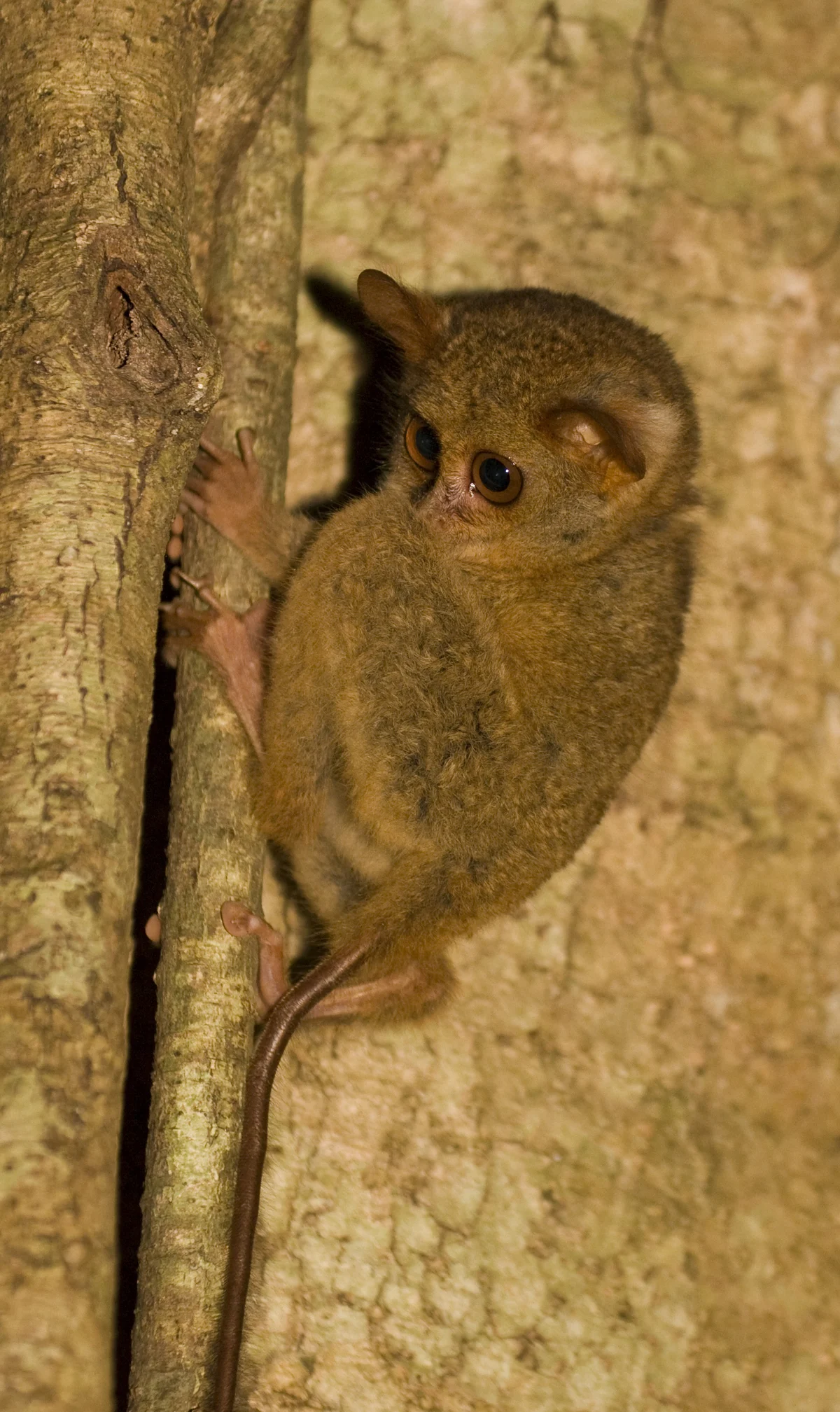
Each finger and toe ends in a disc-shaped adhesive pad that grips smooth vertical surfaces. Combined with sharp claw-like nails on their second and third toes for grooming, they can cling to almost anything.
Tarsiers communicate partly at frequencies above human hearing range (up to 91 kHz). Families coordinate silent hunts and territory calls that other animals — and tourists — cannot detect.
Unlike many primates, tarsiers form strong pair bonds. A mated pair will share the same sleeping tree for years, raising one offspring at a time. Family groups duet-call at sunrise and dusk.
During the day, tarsiers sleep upright, gripping thin vertical stems or tree roots low to the ground. Their chosen sleeping trees stay consistent for years — making them reliably findable for trained guides.
Daily Behavior
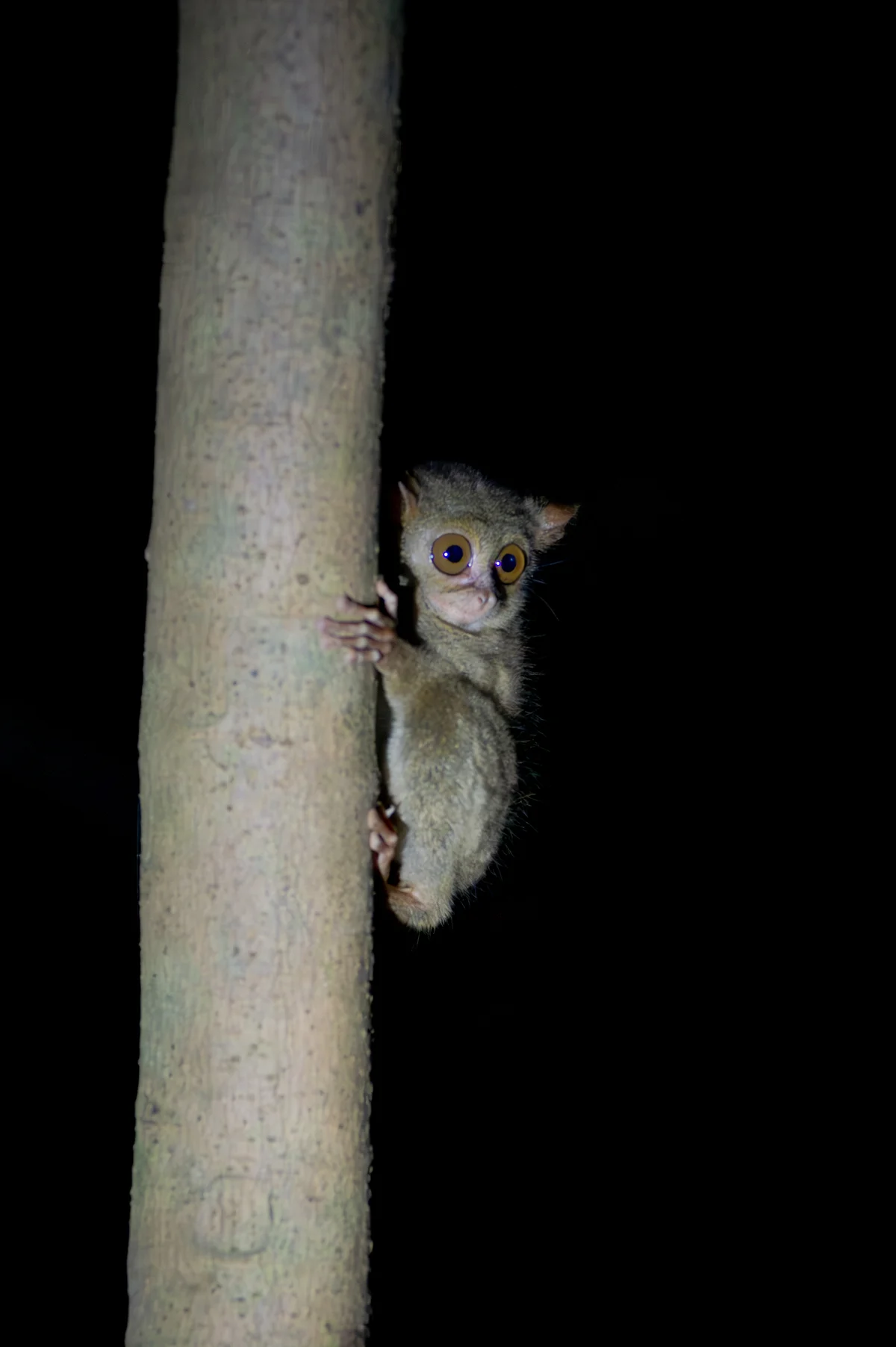
Understanding their daily rhythm helps explain why Tangkoko guided tours time activities around dusk — the magical window when tarsiers wake and begin hunting.
Just before sunrise, the family returns to their sleeping tree…
Tarsiers sleep upright at their roost tree, conserving energy…
This is the golden hour for Tangkoko visitors…
Using their massive eyes and hearing, tarsiers hunt insects…
Between hunts, tarsiers rest and scent-mark their territory…
Conservation Status
The IUCN lists the Spectral Tarsier as Vulnerable. Their numbers are declining across their limited Sulawesi range. Three primary threats drive this trend:
Logging, palm oil expansion, and agricultural clearing have fragmented tarsier habitat across Sulawesi. Tangkoko's protected 3,196-hectare reserve is one of the last intact lowland forest patches in the region.
Unregulated Tourism Pressure Flash photography, touching, and disturbing sleeping tarsiers causes extreme stress and can lead to self-destructive behavior. Responsible, ranger-guided tours with no flash photography protect the animals while still delivering unforgettable experiences.
Tarsiers are sometimes taken from the wild to be sold as pets. This is deeply harmful — they are wild animals that die in captivity within weeks when kept incorrectly, due to stress and dietary needs impossible to replicate outside their ecosystem.
Frequently Asked Questions
Tangkoko Nature Reserve in North Sulawesi is the world’s best location to observe wild Spectral Tarsiers. With a knowledgeable local guide, you can reliably spot families at their sleeping trees at dusk, just 60 km northeast of Manado.
The best viewing window is dusk — roughly 5:30 to 7:00 PM — when tarsiers emerge from their sleeping trees. Guided night walks extend viewing into the early night. Tarsiers are present year-round, though the dry season (May–October) makes trail conditions easier.
No — and responsible guides strictly enforce this. Tarsiers are wild animals and human contact causes them severe stress. Keep a respectful distance (at least 2–3 meters), never use flash photography, and follow your guide’s instructions at all times.
Tangkoko is about 60 km northeast of Manado, roughly a 1.5–2 hour drive. Our tours provide round-trip transport from Manado hotels, a local ranger guide, park fees, and any necessary permits — so you can focus entirely on the wildlife experience.
Tangkoko is extraordinarily biodiverse. Alongside tarsiers, you may encounter the Sulawesi Black Macaque (Yaki), the giant Maleo bird, hornbills, cuscus, green sea turtles on the beach, sea eagles, and dozens of endemic bird species. It is one of the richest wildlife-watching destinations in Asia.
Tarsiers are among the world’s smallest primates, though the tiny mouse lemur of Madagascar is slightly smaller by body weight. What makes tarsiers distinctive is their unique anatomical traits — especially those enormous eyes and extraordinary jumping ability — which make them the most visually striking small primate on the planet.
Also on Tangkoko Tour Blog
All-black, razor-intelligent, and found nowhere else on Earth
A slow-moving marsupial found only in Sulawesi's ancient forests